
Risk Management
Discovery
Account Migration Into A Master Identity
A UX-led decision to prevent high-risk identity consolidation in a multi-brand platform
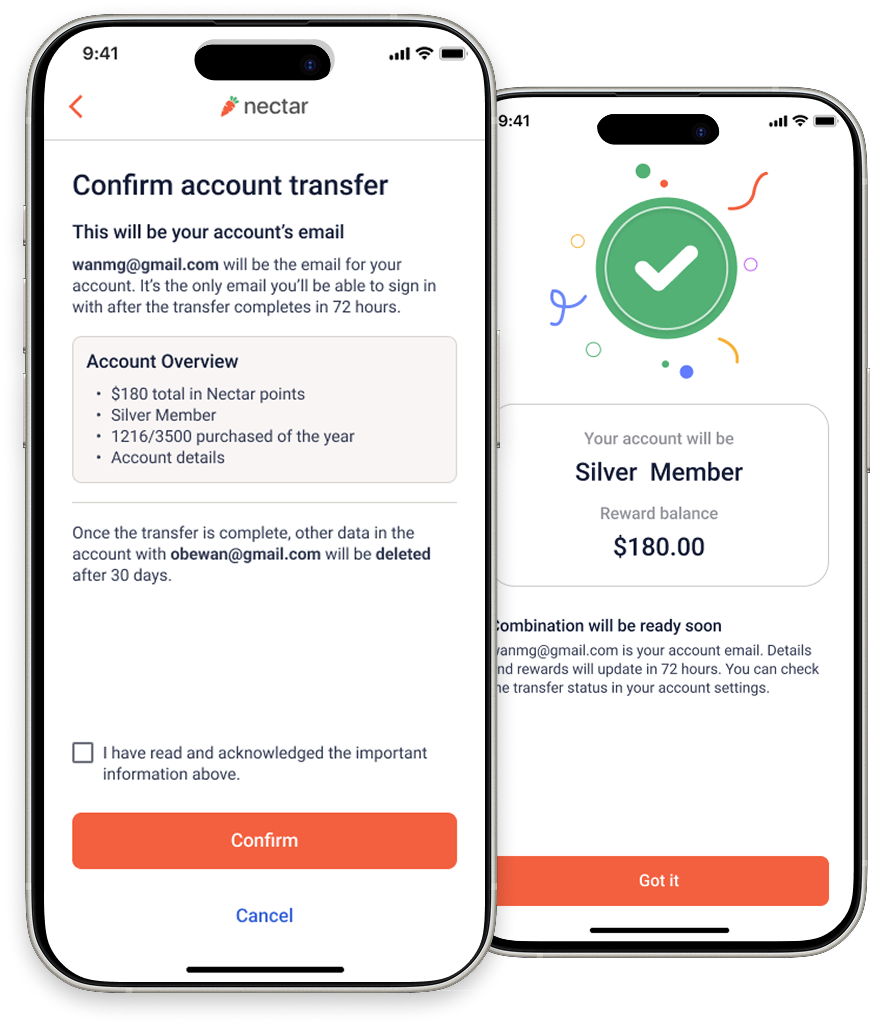
Illustrative example only. Not a final or production UI.
Impact:
- Identified critical security and fraud risks prior to development
- Prevented potential financial loss by halting a high-risk feature before launch
Role: UX Designer (Identity)
Timeline: 3 months
Teams: Engineering, Product, Design, Research, Marketing, and Legal. (6 stakeholders)
Timeline: 3 months
Teams: Engineering, Product, Design, Research, Marketing, and Legal. (6 stakeholders)
What is this?
Context
This case evaluates whether enabling users to merge multiple accounts into a single identity could improve user experience and data quality across a multi-brand rewards ecosystem.
Why does it matter?
The Problem
The launch of a unified rewards program introduced system-level challenges, including duplicated identities, and increased complexity in account management and data integrity.
How was it solved?
Solution
Evaluated the feasibility by exploring a potential account merge experience supported by qualitative and quantitative research.
The exploration focused on assessing business data management, security, and system risks before committing to development.
The exploration focused on assessing business data management, security, and system risks before committing to development.
What changed?
Impact
The insights uncovered critical security vulnerabilities and potential financial exposure from promotional reward abuse.
A UX-led recommendation to halt the initiative prevented unnecessary engineering investment and averted long-term financial and trust damage to the business.
My role in this case
- Partnered closely with UX Research to conduct research and synthesis
- Evaluated user trust, authentication, and identity ownership risks
- Brought forward concerns around security, reward rollover, and fraud scenarios
- Influenced product decision-making by framing risks beyond usability alone
Decision Process
Understanding the Real Pain Points
Why are we solving this?
Analytics revealed a high volume of users creating accounts with different email addresses across brands prior to the unified rewards launch. In many cases, users reported forgetting which email was associated with an existing account frequently led to duplicate registrations.
While account consolidation initially appeared to be a usability improvement, the deeper challenge extended beyond duplication. The challenge raised questions around identity ownership, verification, and risk exposure.
While account consolidation initially appeared to be a usability improvement, the deeper challenge extended beyond duplication. The challenge raised questions around identity ownership, verification, and risk exposure.
Business Evaluation & Product Requirements
What business impact we could bring?
We evaluated whether account consolidation could:
- Reduce long-term account maintenance costs
- Improve data accuracy and analytics
- Simplify the rewards experience for users
However, these benefits depended heavily on secure identity verification and strict constraints around data rollover.
Design Strategy & Explorations
How I approached before creating the experience?
Before designing flows, we partnered with Research team to validate:
- Whether users actually wanted to merge accounts
- Which data users valued most and feared losing
- Whether the merge experience reduced friction or introduced anxiety
These insights informed decisions around what data to surface, what safeguards to communicate, and how to maintain user trust during account migration.
Design × Technology Trade-offs
Stopping before irreversible damage
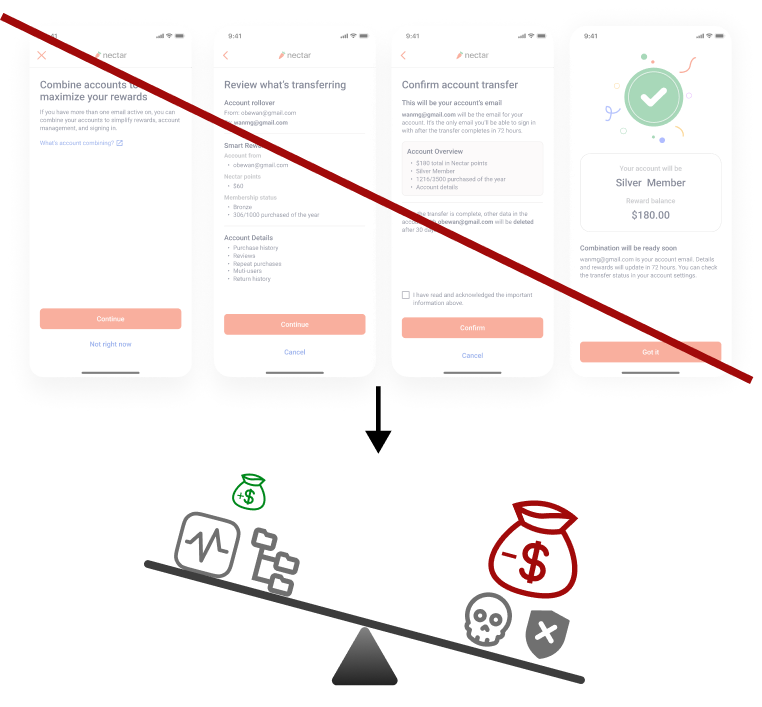
Although the experience itself tested well conceptually, further reviews uncovered severe abuse scenarios. Scammers could repeatedly create and merge accounts to exploit promotional rewards which leading to significant financial loss.
Solution Highlights
Designing Data Rollovers Based on User Value, Not System Capability
Rather than transferring all available data, we questioned what information truly mattered to users during account migration.
To avoid cognitive overload and loss of trust, we combined user interviews with quantitative research to identify and prioritize the most critical data in the experience.
This approach:
This approach:
- Reduced cognitive load and improved scannability at each step
- Clarified user actions and decision-making during migration
- Maintained user trust without introducing confusion or hesitation
- Minimized unnecessary data processing and system overhead
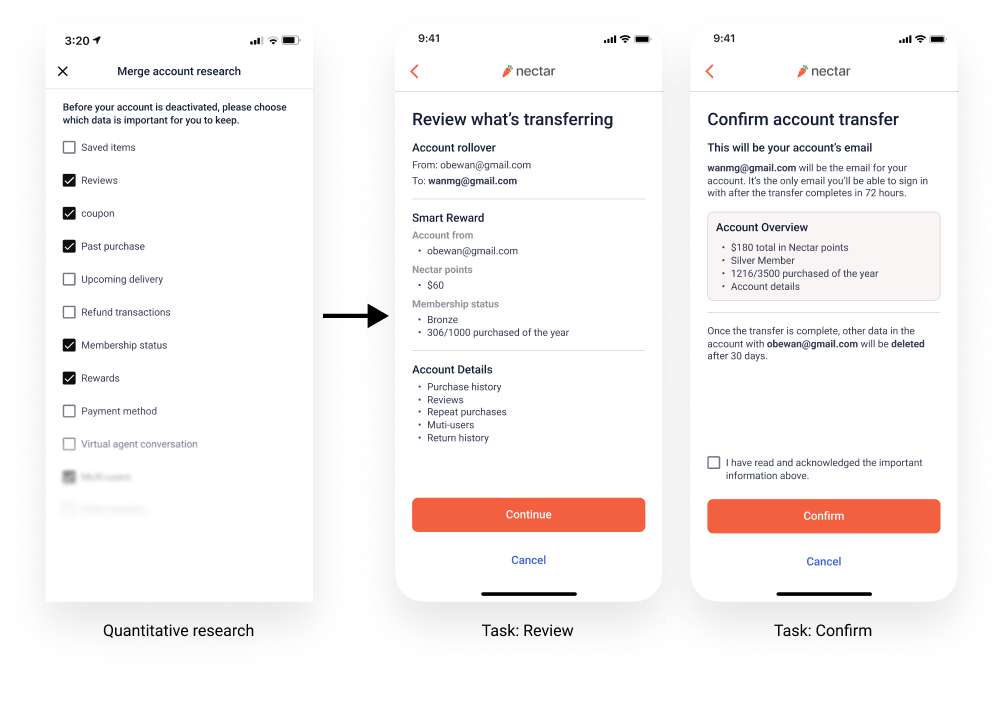

Quantitative research

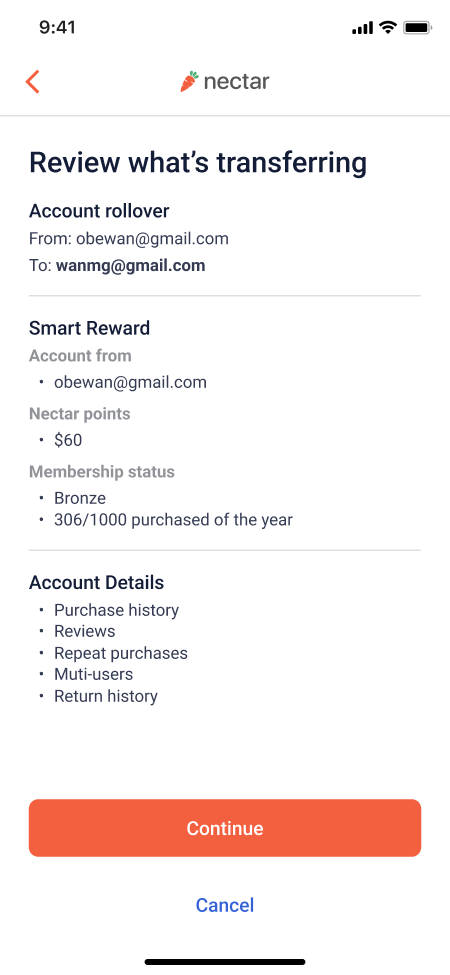
Task: Review
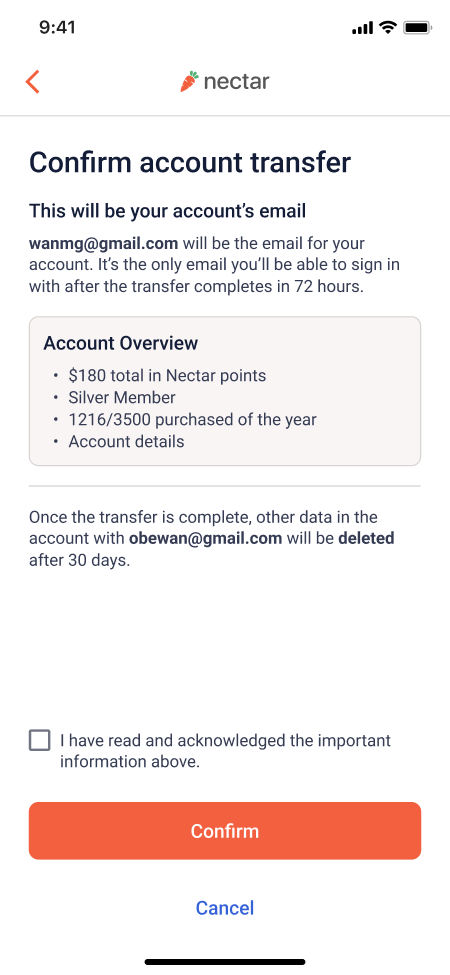
Task: Confirm
Illustrative example only. Not a final or production UI.
Usability vs. Business Risk Trade-off
While we designed an intuitive experience that allowed users to merge multiple accounts, cross-functional reviews revealed a critical risk, which users could repeatedly create and merge new accounts to accumulate promotional rewards. This behavior would be difficult to detect or legally prevent, and could create a high potential for fraud and long-term financial loss.
When weighing the benefits of improved data quality against the cost of reward abuse, we determined that the financial and security risks significantly outweighed the operational gains.
The decision not to proceed with the launch resulted in:
When weighing the benefits of improved data quality against the cost of reward abuse, we determined that the financial and security risks significantly outweighed the operational gains.
The decision not to proceed with the launch resulted in:
- Prevented unnecessary engineering investment
- Identified and mitigated security and fraud risks before development
- Protected the business from long-term financial exposure related to reward abuse before launch
Illustrative example only. Not a final or production UI.


